Sunday, 1 February 2015

Animation progress

        We were ask to make an animation about 2 min length. The animation must be about something that can remind you of your hometown and its culture.

         My animation is about a "ketupat" that tell the bad activities that happens on Hari Raya Aidilfitri. The ketupat is more of a story teller. The main character is a boy (Kasim)  who do the bad activities.

Character Design

Image 1: Mr. Ketupat

Image 2: Kasim (Main character design)

Image 3: Kasim (Main character design?


Background

Background 1

Background 2

Background 3

Background 4

Character body parts

      The reason I have images of the character body part is because I use this body parts to make the character movement quicker.If I draw one by one, it will takes a lot of time to finish it. Using body parts, I just need to scan them and edit them in Photoshop. This also include the background. There are the parts of their hands, legs mouth, eyes.
Image 3: Hand part

Image 4: Mouth part

Imaging for Narrative and Storyboards ( Deaf & Dumb Dad)

We were ask to make a storyboard of a short video name "Deaf & Dumb Dad". We must apply suitable camera angle  and for the background and characters, we draw depend on our style of drawing that we want. This is the video that we were ask to make the storyboard:

Video 1: Deaf & Dumb Dad

This is the storyboard that I've made:

Image page 1

Image page 2

Image page 3

The video is about a child who hates his dad who is deaf. People around her always tease her about her dad.until she cant stand it. Meanwhile, her dad always try make her life chearful and always by her side to support her. However the child doesnt realize it and tried to commit suicide. At the end, then she realize when her dad secrifice himself to save her life.


2D Animation (Structure)

This week, we were ask to draw structure drawings. The drawings does not has to be people. We can draw animals and object too. Here are some drawings that I drawn:

Image 1

Image 2

Image 3

Image 4

Image 5

Image 6


This concept is very interesting to me because i've learned a lot about structure drawing from my previous school and now I can learn more about it. Structure drawing is more like a 3D image drawings .

2D Animation (Movement)

This week, we were ask to draw movement drawings. The drawings does not has to be people. We can draw animals and object too. Here are some drawings that I drawn:

Image 1

Image 2

Image 3

Image 4

Image 5

Image 6

Image 7

Image 8


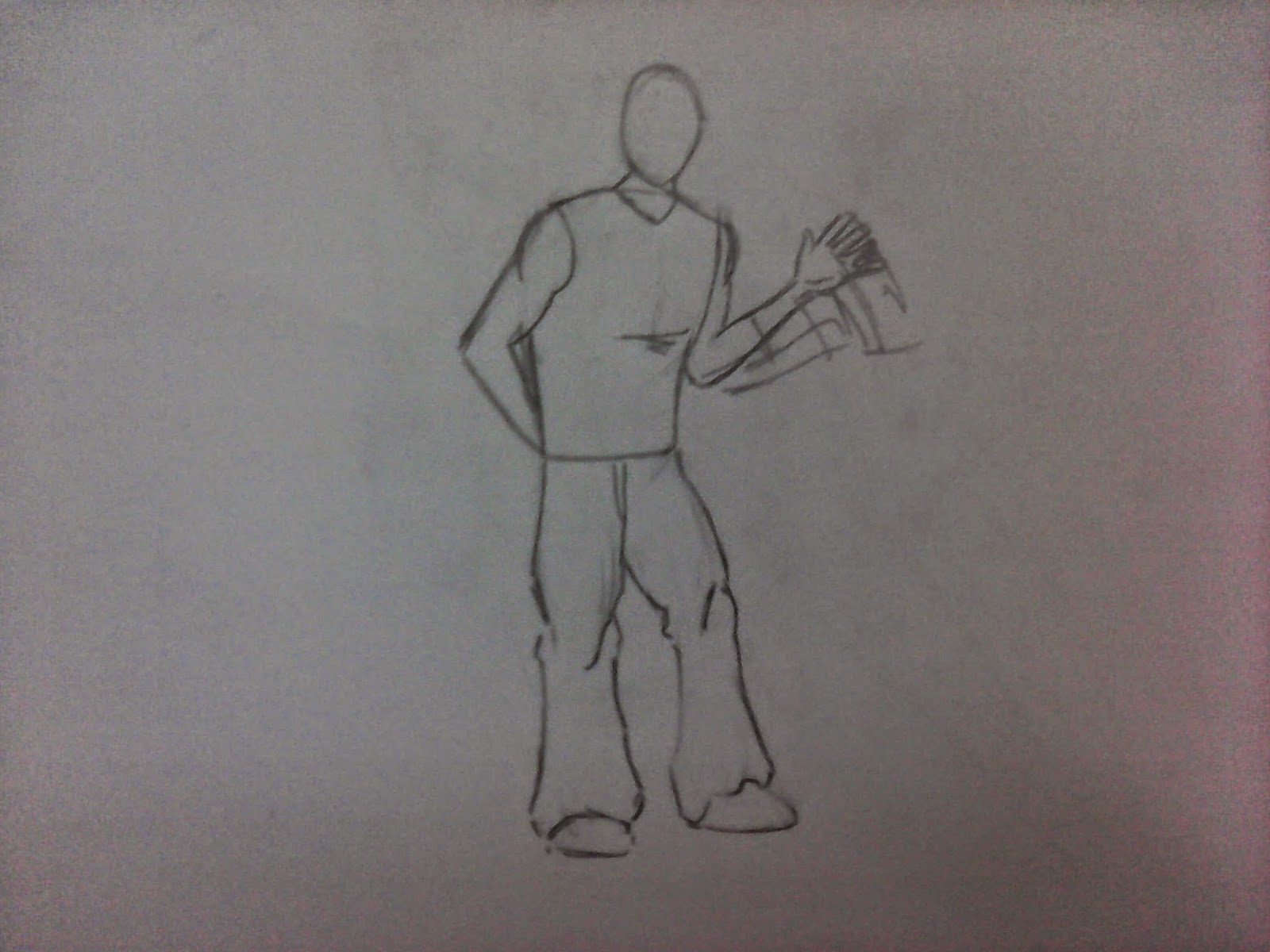
To me, this concept is hard because I'm not very good at drawing human body parts. To challenge myself, I keep on drawing human body with different movement. 

Sunday, 25 January 2015

2D Character Animation (12 Principle of Animation)

1. SQUASH AND STRETCH
This action gives the illusion of weight and volume to a character as it moves. Also squash and stretch is useful in animating dialogue and doing facial expressions. How extreme the use of squash and stretch is, depends on what is required in animating the scene. Usually it's broader in a short style of picture and subtler in a feature. It is used in all forms of character animation from a bouncing ball to the body weight of a person walking. This is the most important element you will be required to master and will be used often.

2. ANTICIPATION
This movement prepares the audience for a major action the character is about to perform, such as, starting to run, jump or change expression. A dancer does not just leap off the floor. A backwards motion occurs before the forward action is executed. The backward motion is the anticipation. A comic effect can be done by not using anticipation after a series of gags that used anticipation. Almost all real action has major or minor anticipation such as a pitcher's wind-up or a golfers' back swing. Feature animation is often less broad than short animation unless a scene requires it to develop a characters personality.

3. STAGING
A pose or action should clearly communicate to the audience the attitude, mood, reaction or idea of the character as it relates to the story and continuity of the story line. The effective use of long, medium, or close up shots, as well as camera angles also helps in telling the story. There is a limited amount of time in a film, so each sequence, scene and frame of film must relate to the overall story. Do not confuse the audience with too many actions at once. Use one action clearly stated to get the idea across, unless you are animating a scene that is to depict clutter and confusion. Staging directs the audience's attention to the story or idea being told. Care must be taken in background design so it isn't obscuring the animation or competing with it due to excess detail behind the animation. Background and animation should work together as a pictorial unit in a scene.

4. STRAIGHT AHEAD AND POSE TO POSE ANIMATION
Straight ahead animation starts at the first drawing and works drawing to drawing to the end of a scene. You can lose size, volume, and proportions with this method, but it does have spontaneity and freshness. Fast, wild action scenes are done this way. Pose to Pose is more planned out and charted with key drawings done at intervals throughout the scene. Size, volumes, and proportions are controlled better this way, as is the action. The lead animator will turn charting and keys over to his assistant. An assistant can be better used with this method so that the animator doesn't have to draw every drawing in a scene. An animator can do more scenes this way and concentrate on the planning of the animation. Many scenes use a bit of both methods of animation.

5. FOLLOW THROUGH AND OVERLAPPING ACTION
When the main body of the character stops all other parts continue to catch up to the main mass of the character, such as arms, long hair, clothing, coat tails or a dress, floppy ears or a long tail (these follow the path of action). Nothing stops all at once. This is follow through. Overlapping action is when the character changes direction while his clothes or hair continues forward. The character is going in a new direction, to be followed, a number of frames later, by his clothes in the new direction. "DRAG," in animation, for example, would be when Goofy starts to run, but his head, ears, upper body, and clothes do not keep up with his legs. In features, this type of action is done more subtly. Example: When Snow White starts to dance, her dress does not begin to move with her immediately but catches up a few frames later. Long hair and animal tail will also be handled in the same manner. Timing becomes critical to the effectiveness of drag and the overlapping action.

6. SLOW-OUT AND SLOW-IN
As action starts, we have more drawings near the starting pose, one or two in the middle, and more drawings near the next pose. Fewer drawings make the action faster and more drawings make the action slower. Slow-ins and slow-outs soften the action, making it more life-like. For a gag action, we may omit some slow-out or slow-ins for shock appeal or the surprise element. This will give more snap to the scene. 

7. ARCS
All actions, with few exceptions (such as the animation of a mechanical device), follow an arc or slightly circular path. This is especially true of the human figure and the action of animals. Arcs give animation a more natural action and better flow. Think of natural movements in the terms of a pendulum swinging. All arm movement, head turns and even eye movements are executed on an arcs.

8. SECONDARY ACTION
This action adds to and enriches the main action and adds more dimension to the character animation, supplementing and/or re-enforcing the main action. Example: A character is angrily walking toward another character. The walk is forceful, aggressive, and forward leaning. The leg action is just short of a stomping walk. The secondary action is a few strong gestures of the arms working with the walk. Also, the possibility of dialogue being delivered at the same time with tilts and turns of the head to accentuate the walk and dialogue, but not so much as to distract from the walk action. All of these actions should work together in support of one another. Think of the walk as the primary action and arm swings, head bounce and all other actions of the body as secondary or supporting action.

9. TIMING
Expertise in timing comes best with experience and personal experimentation, using the trial and error method in refining technique. The basics are: more drawings between poses slow and smooth the action. Fewer drawings make the action faster and crisper. A variety of slow and fast timing within a scene adds texture and interest to the movement. Most animation is done on twos (one drawing photographed on two frames of film) or on ones (one drawing photographed on each frame of film). Twos are used most of the time, and ones are used during camera moves such as trucks, pans and occasionally for subtle and quick dialogue animation. Also, there is timing in the acting of a character to establish mood, emotion, and reaction to another character or to a situation. Studying movement of actors and performers on stage and in films is useful when animating human or animal characters. This frame by frame examination of film footage will aid you in understanding timing for animation. This is a great way to learn from the others.

10. EXAGGERATION
Exaggeration is not extreme distortion of a drawing or extremely broad, violent action all the time. Its like a caricature of facial features, expressions, poses, attitudes and actions. Action traced from live action film can be accurate, but stiff and mechanical. In feature animation, a character must move more broadly to look natural. The same is true of facial expressions, but the action should not be as broad as in a short cartoon style. Exaggeration in a walk or an eye movement or even a head turn will give your film more appeal. Use good taste and common sense to keep from becoming too theatrical and excessively animated.

11. SOLID DRAWING
The basic principles of drawing form, weight, volume solidity and the illusion of three dimension apply to animation as it does to academic drawing. The way you draw cartoons, you draw in the classical sense, using pencil sketches and drawings for reproduction of life. You transform these into color and movement giving the characters the illusion of three-and four-dimensional life. Three dimensional is movement in space. The fourth dimension is movement in time.

12. APPEAL
A live performer has charisma. An animated character has appeal. Appealing animation does not mean just being cute and cuddly. All characters have to have appeal whether they are heroic, villainous, comic or cute. Appeal, as you will use it, includes an easy to read design, clear drawing, and personality development that will capture and involve the audience's interest. Early cartoons were basically a series of gags strung together on a main theme. Over the years, the artists have learned that to produce a feature there was a need for story continuity, character development and a higher quality of artwork throughout the entire production. Like all forms of story telling, the feature has to appeal to the mind as well as to the eye.

Sunday, 19 October 2014

Critical Thinking ( Task 4): Packaging proposal

Problem Statement

Packaging serves as one of the most influential form of communication with consumers since it provides a first hand experience for individuals. However, there are lots of packaging that is not suitable for its product and the design not convincing to the audience.


Aim
  1. Minimizing the waste in order to save more material
  2. Design the packaging suitable for the product to make it more interesting  which will attract the audience
  3. Design the packaging appropriate  for the specific audience
  4. Make sure the product is safe when it is transported


Objective
  1. Use a recyclable materials for the packaging
  2. Use suitable colour for the design which will attract the audiences attention
  3. Use suitable materials to make sure the product will be secure
  4. Make sure all the labels and information is well placed on the packaging


What's Wrong with the Packaging?
  1. The product can easily fell off from the packaging because the the side of the packaging is not covered and this will cause the product easily get damage.
  2. The packaging has too many colours. Too many colour makes the font on the packaging not visible and will make the packaging unappropriated with the product. Colourful packaging only suitable for toys.
  3. There are no brand on the packaging. Brand give a lot of impact on the packaging because brand is the core of attraction. A well known brand will easily get customer. Without brand, customer will not know the origin of the product.

Problem Solution
  1. Use transparent plastic paper for the packaging. The product can easily damage if it gets wet. So instead of using cardboard that can easily get wet, I change the material by using transparent plastic paper.
  2. Use suitable colour on the packaging to make it looks attractive and suitable with the product. This also helps to make the fonts on the packaging visible
  3. Apply the brand of the company on the packaging. So that people will know which company the product belongs too.
  4. Apply  a spring like function on the cover so that even if it fell, the product will bounce back because of the spring.


20th Century Design ( task 1)

Instagram
 

Tast:

Working in groups use mobile phones and cameras to capture footage and explore how sequence works.